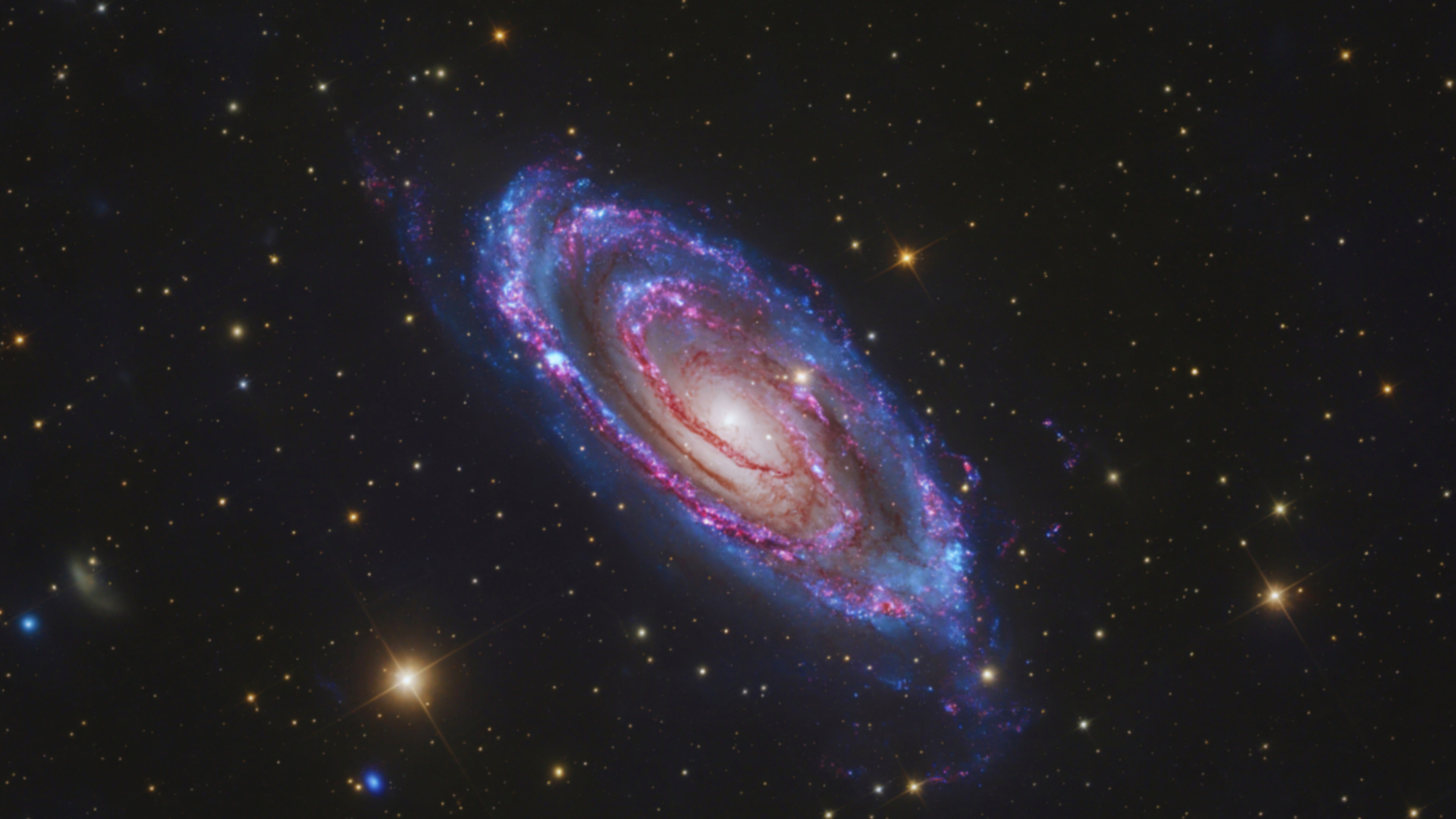
Stars begin their life in vast clouds of gas and dust called nebulae, where gravity pulls matter together until nuclear fusion ignites. The life cycle of stars follows a path from formation to fusion-powered stability, and for some, ends dramatically in a supernova explosion. This process is a fundamental aspect of stellar evolution and shapes the universe.
As stars burn hydrogen into heavier elements, their internal balance shifts, leading to different stages depending on their mass. Massive stars experience more complex changes, eventually collapsing and releasing energy in a supernova, which disperses elements necessary for new stars and planets.
Understanding the life cycle of stars reveals how matter recycles through the universe and influences cosmic structure. This cycle connects the birth and death of stars, illustrating their role in creating the elements found throughout space.
Star Formation and Birth
Stars begin as dense regions within vast clouds of gas and dust. Changes in gravity and temperature drive the transformation from cold clouds to luminous stellar bodies. The process involves complex interactions in molecular clouds, collapse driven by gravity, and the eventual ignition of nuclear fusion.
Molecular Clouds and Stellar Nurseries
Star formation starts in molecular clouds, cold and dense regions mainly composed of hydrogen molecules within the interstellar medium. These clouds, sometimes called stellar nurseries, provide the raw material for stars. Their temperature typically ranges from 10 to 20 K, allowing gas to remain mostly molecular rather than atomic or ionized.
The Orion Nebula is a well-known example of a stellar nursery, where many stars and planets form. Inside these nebulae, gravity can cause parts of the cloud to gather and increase in density. External events like nearby supernovae or shock waves often trigger this gathering by compressing the gas.
Gravitational Collapse and Protostar Formation
As a region within a molecular cloud gains density, gravity causes it to collapse inward. This gravitational collapse leads to the formation of a protostar, a dense, hot core surrounded by an envelope of gas and dust. The core’s temperature rises as matter falls inward and compresses.
During this phase, protostars generate energy largely from gravitational contraction, not yet from fusion. They are often obscured by dust but can be observed in infrared. The balance between gravity pulling inward and pressure pushing outward defines the protostar’s evolving structure.
Initiation of Nuclear Fusion
When the core temperature of the protostar reaches about 10 million Kelvin, hydrogen nuclei begin to fuse. This fusion process marks the start of stellar nucleosynthesis and the birth of a true star. The two main fusion pathways are the proton-proton chain, dominant in smaller stars, and the CNO cycle, more common in massive stars.
The onset of hydrogen fusion produces energy that halts the gravitational collapse. This energy output stabilizes the star, allowing it to enter the main sequence phase, where it will spend most of its life. The balance of forces at this stage also determines the star’s classification and future evolution.
Main Sequence Evolution
During the main sequence phase, stars generate energy by fusing hydrogen into helium in their cores. Their properties, such as luminosity and temperature, depend heavily on mass and composition. This stage is well-defined on the Hertzsprung-Russell diagram, marking a stable period in stellar evolution.
Main Sequence Star Characteristics
Main-sequence stars maintain hydrostatic equilibrium where outward pressure from nuclear fusion balances gravitational forces. Their luminosity ranges widely, from dim M-type stars to very bright O-type stars.
The star’s temperature correlates with spectral classification: cooler stars fall under M-type with temperatures around 3,000 K, while hot O-type stars exceed 30,000 K. The Sun, a G-type star with about 1 solar mass, serves as a typical example of main-sequence properties.
These stars exhibit consistent photometry and spectroscopy features, allowing astronomers to estimate their age and mass through stellar evolution models. Their lifetimes during this phase vary from millions to billions of years, depending mainly on mass.
Nuclear Fusion Processes
Hydrogen fusion is the hallmark of main-sequence stars, occurring primarily through the proton-proton chain reaction in stars like the Sun. This process converts hydrogen nuclei into helium, releasing energy that sustains the star’s luminosity.
More massive stars rely predominantly on the CNO (carbon-nitrogen-oxygen) cycle for fusion, which requires higher core temperatures exceeding 15 million K. The produced helium accumulates in the core until hydrogen is depleted.
Energy output, measured by luminosity, directly ties to these fusion processes. The efficiency and rate affect the star’s size and temperature, influencing main-sequence duration and future evolution.
Role of Stellar Mass and Classification
Stellar mass is the principal factor governing a main-sequence star’s position on the Hertzsprung-Russell diagram. Higher mass stars exhibit greater luminosity and temperature, appearing towards the upper left, while low mass stars cluster toward the lower right.
Classification ranges from O-type (about 16 solar masses or more) to M-type stars (less than 0.5 solar masses), encompassing a variety of fusion rates and stellar lifetimes. Mass also dictates fusion pathways: low mass stars use the proton-proton chains, whereas high mass stars engage the CNO cycle.
This mass dependency shapes the star’s evolutionary path, affecting its transition out of the main sequence phase into later stages such as red giants or supernova progenitors.
Stellar Aging and Death
Stars evolve through distinct stages as their internal fuel depletes and their cores experience changes in pressure and temperature. These transformations depend heavily on the star’s initial mass and dictate whether it ends as a white dwarf, neutron star, or black hole.
Red Giant and Supergiant Phases
Low-mass stars enter the red giant phase after exhausting hydrogen in their cores. The core contracts while hydrogen fusion continues in a surrounding shell. The star expands and cools, increasing luminosity and size dramatically.
Massive stars become supergiants, fusing heavier elements like carbon and oxygen in their cores. Their large mass causes intense gravitational contraction, driving fusion of elements up to iron. This process is short-lived compared to the star’s main-sequence lifespan.
Both red giants and supergiants exhibit unstable outer layers prone to pulsations and mass loss. The star’s outer atmosphere expands, sometimes ejecting material into space, enriching the cosmos with heavier elements.
Planetary Nebulae and White Dwarfs
Low-mass stars shed their outer layers, creating planetary nebulae, intricate shells of ionized gas visible as glowing clouds. This occurs once helium fusion ends, and the core becomes exposed.
The remaining core forms a white dwarf, a dense stellar remnant composed mostly of carbon and oxygen. White dwarfs no longer undergo fusion and slowly cool over billions of years, supported by electron degeneracy pressure.
White dwarfs have masses up to about 1.4 times that of the Sun. If they gain mass beyond this limit, they can explode as type Ia supernovae, but generally, they fade quietly in the cosmos.
Core Collapse and Supernova Explosions
High-mass stars face core collapse when iron accumulates in the core, preventing further fusion and halting energy production. The core collapses under gravity in seconds, raising densities to nuclear levels.
This collapse triggers a supernova explosion, releasing enormous energy and producing heavy elements beyond iron. The explosion disperses stellar material, enriching the interstellar medium and leaving behind a compact remnant.
Supernova explosions can outshine entire galaxies temporarily and contribute to the cosmic heavy element distribution essential for planet and life formation.
Formation of Neutron Stars and Black Holes
The outcome after a supernova depends on the residue’s mass. Remnants between about 1.4 and 3 solar masses become neutron stars—dense objects composed mostly of neutrons, supported by neutron degeneracy pressure.
Neutron stars often manifest as pulsars, emitting beams of radiation due to rapid rotation and strong magnetic fields. They represent compact remnants where quantum forces resist further collapse.
If the remnant mass exceeds roughly 3 solar masses, gravitational contraction overcomes all pressures, forming a black hole. These objects create gravitational wells from which not even light can escape, influencing surrounding matter and spacetime.
Both neutron stars and black holes are key components of supernova remnants, marking the endpoints of stellar evolution for massive stars.